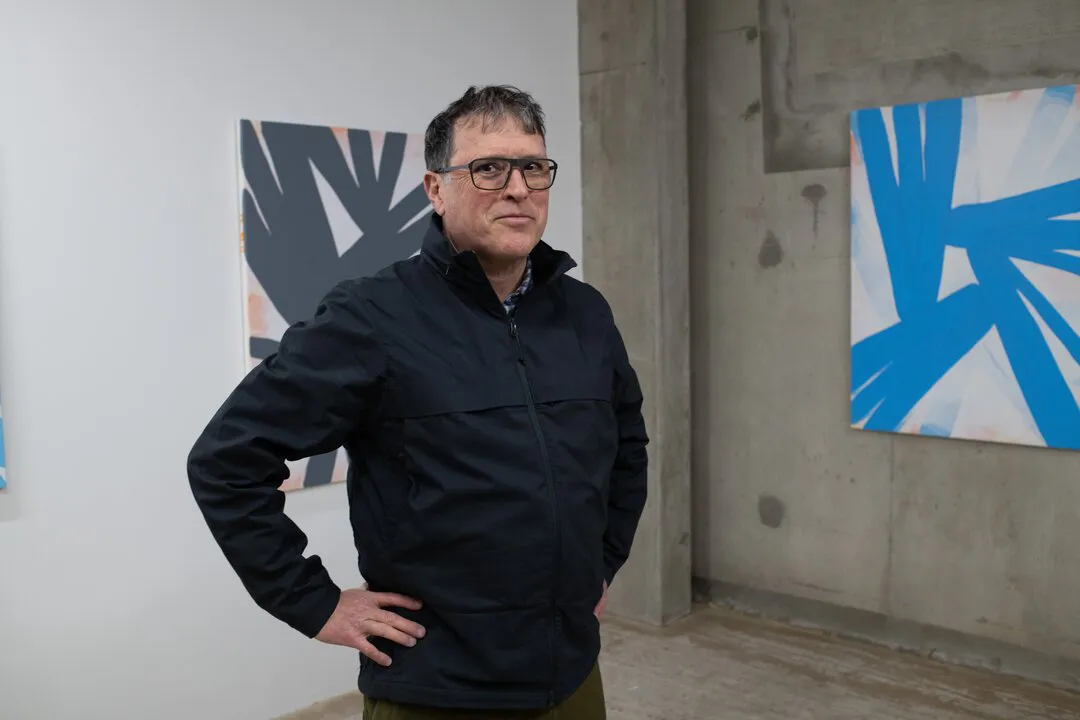
Artist Ambassador Haroon Mirza
Over the autumn season, we are getting to know our ambassadors more. We settled in with Haroon Mirza, a celebrated artist who was previously a Creative Land Trust (CLT) Trustee, and now an ambassador. Mirza's work explores electricity, sound, light, and the blurred boundaries between natural and artificial worlds. He's shown work internationally, won the Silver Lion at the Venice Biennale.
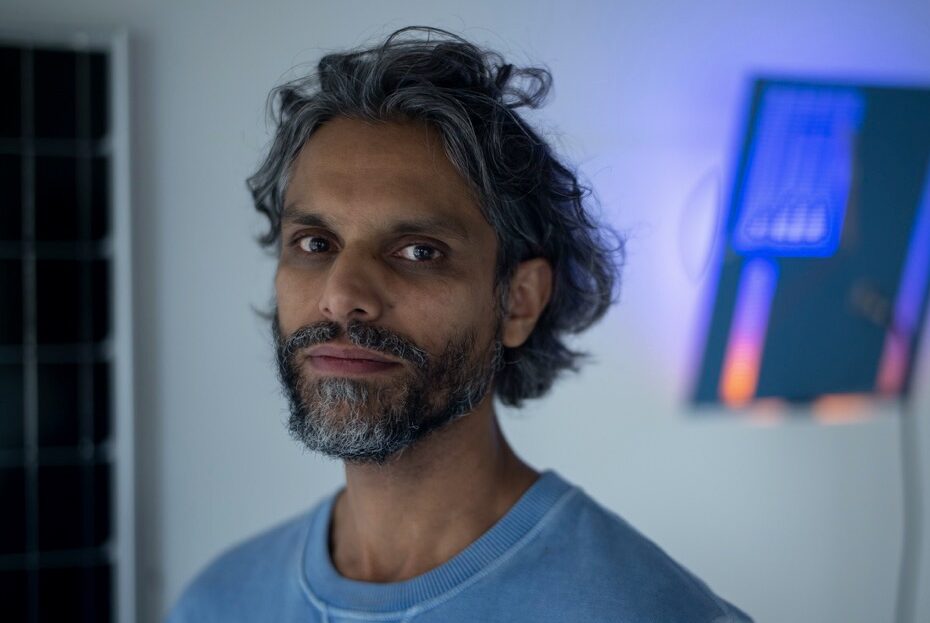
In this interview between Piarvé Wetshi at Creative Land Trust, and Haroon, we have a candid conversation about the decline in artist studios, even for established artists; his work over the years; and why infrastructure matters more than most people realise.
Piarvé Wetshi (PW): If you could describe your practice in less than 10 words, what would that be?
Haroon Mirza (HM): So I work with electricity, waves, frequencies, energy and power. Amongst other things, theology, I’d say.
PW: Your work is truly interdisciplinary. Tell me a project where you merged sound with another form that had unexpected consequences.
HM: A lot of my work pivots around generating sound from electronics designed to create light so LEDs and such. By connecting an amplifier and speakers to the poles of the LED, you can hear the electricity tha runs through it. That was quite an unexpected thing I discovered whilst a student at Goldsmiths and I still work with that process today.
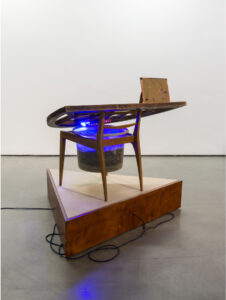
Haroon Mirza Lamp for Williamsii, 2016
PW: When you were at Goldsmiths, did you have a studio? And how did your first studio impact your career?
HM: No, I didn't have my own studio at Goldsmiths, I studied Design there. We had desk space and other bits to experiment. My first proper studio was before Goldsmiths, in my dad's double garage, which I shared with the household storage and his tools. Luckily he didn't park his car in there so I had a bit more space.
PW: I've seen household items placed in some of your work, such as the piece exhibited during the MELT Exhibition Creative Land Trust did with Hypha Studio. How has this practice evolve overtime?
HM: When I was at my dad's, I didn't use household items. I was using the space as a painting studio mainly. But after Goldsmiths, I started using household materials. I'd go to Deptford Market and pick up random things; old radios, lamps, furniture.
PW: I know you collect a lot of vintage pieces. What's the most interesting one you've come across and how did it feed into your work?
I don't really collect stuff anymore. I don't have the space for it. But I did hoard things, sometimes for several years before I knew how I'd use them. One particular item I remember: I was on holiday in Morocco with my girlfriend at the time and I found this antique door arch in Rabat, a relieving arch that goes on top of a doorway. Wooden frame with Islamic geometric forms and Iraqi glass. Somebody told me that glass was probably a few hundred years old. It was a beautiful object. I literally carried it around for the rest of the holiday with me everywhere I went.
I ended up putting it on the plane wrapped in bubble wrap. It moved from studio to studio, and then in 2016 it got incorporated into a work called Lamp for Williamsii.
PW: When I've seen your recent work, there's an exploration in sound and spirituality. What have you learned through this process?
HM: Sound has always been an integral part of spirituality. There's no religious order, shamanic practice or indigenous group that don't incorporate some kind of sonic ritual, vocal chanting or musical practice into their culture and customs.
I grew up in a Muslim family and I'm not religious at all, but one of the things I struggled with as a kid was that in some Islamic fractions, music is haram. There's a limitation on how you engage with music. But actually, musicality is embedded in the way Islam is practiced. The call to prayer, the reciting of the Quran, is very musical for instance.
The resistance against music are based on dogmas that have emerged over time. So it's interesting to look at contemporary practices and rituals. I think being an artist is itself a sort of shamanic practice where we're engaging with something other and trying to communicate that with the rest of us, creating contemporary rituals with through technology and discourses.
PW: What was your big break as an artist?
HM: What's more important is all the little things I did before anything major happened. Working with artist-led spaces like S1 Art Workspace in Sheffield for instance. Those formative years and projects were way more important than any big break, because it represented all the groundwork. If it wasn't for developing a practice with peers in a grassroots way, literally building studios and communities. I don't think I would have won the Northern Art Prize or joined Lisson Gallery.
PW: How did you end up in Sheffield?
HM: I was studying in London, Goldsmiths and then Chelsea. Then my partner at the time was appointed as the Director of S1 Artspace. London was already unaffordable for me. So I moved up to Sheffield, a little kicking and screaming if I'm honest. I didn't really want to, but I did. After a short time, I found it incredible. Being in a place where you can have space, peers, and time to think and work was really valuable.
“Being in a place where you can have space, peers, and time to think, that was really valuable.”
PW: If you started your career now, what would be different?
HM: I wouldn’t stay in London. I would go to a place where it was affordable, where you could have space and think and evolve. London has become an extremely hostile place for artists. That’s why the Creative Land Trust is really important.
Because there is an exodus. Universities and art schools are occupied by people who don’t stay in London. They come to study and then leave again. Art schools are in crisis because they became dependant on international students who aren’t even coming anymore due to Brexit and other political tensions. There’s a massive vacuum both in revenue and international community. So I think it’s through investing in culture at a grassroots educational level that we can turn things around.
PW: What brought you back to London?
HM: When I was in Sheffield, I had a really great time. But there were demands for my work. On a personal note, I’d broken up with my partner, which made Sheffield complicated. I did a residency at Acme Studios, a live-work residency at a Fire Station in Bromley-by-Bow. That was one of the best things I’ve done. Having a live workspace in London was really useful, and I learned my optimal modus operandi, to live and work in the same space.
When I was at Acme in that comparatively modest studio, I was invited to participate in the 54th Venice Biennale. I ended up winning the Silver Lion there and my career exploded at from that point. I got a much bigger studio in Hoxton and, things picked up. Hoxton was already overpriced, so after a stint in Wood Green, I was in a position to buy a commercial unit in Hackney Wick and convert it into live– work space. That was really great. But due to an acrimonious divorce, I don’t have it anymore.
Interestingly, and this is the irony of serving the CLT for so many years, I am someone that doesn’t have a studio. I’m unable to secure a studio in London right now. So although I’m an established artist, showing my work internationally, as an ex-trustee and a current ambassador for CLT, I can’t afford studio space in London.
PW: It is a very tough landscape for artists at the moment. What are your hopes for the future of artists in the city?
HM: The problem in London is twofold. One is workspace, affordable workspace. But affordable workspace is pointless without affordable living space. You can’t have a really cheap studio if you can’t afford to live close by, you may as well live somewhere else and get a cheaper studio there.
For me, a live–work space is the ideal situation. The building where my studio was in Hackney Wick, and the neighboring building were designed as live–work units. That’s the planning permission they were granted by the LDC. But as soon as they were built, they got turned into large “luxury” apartments – completely residential.
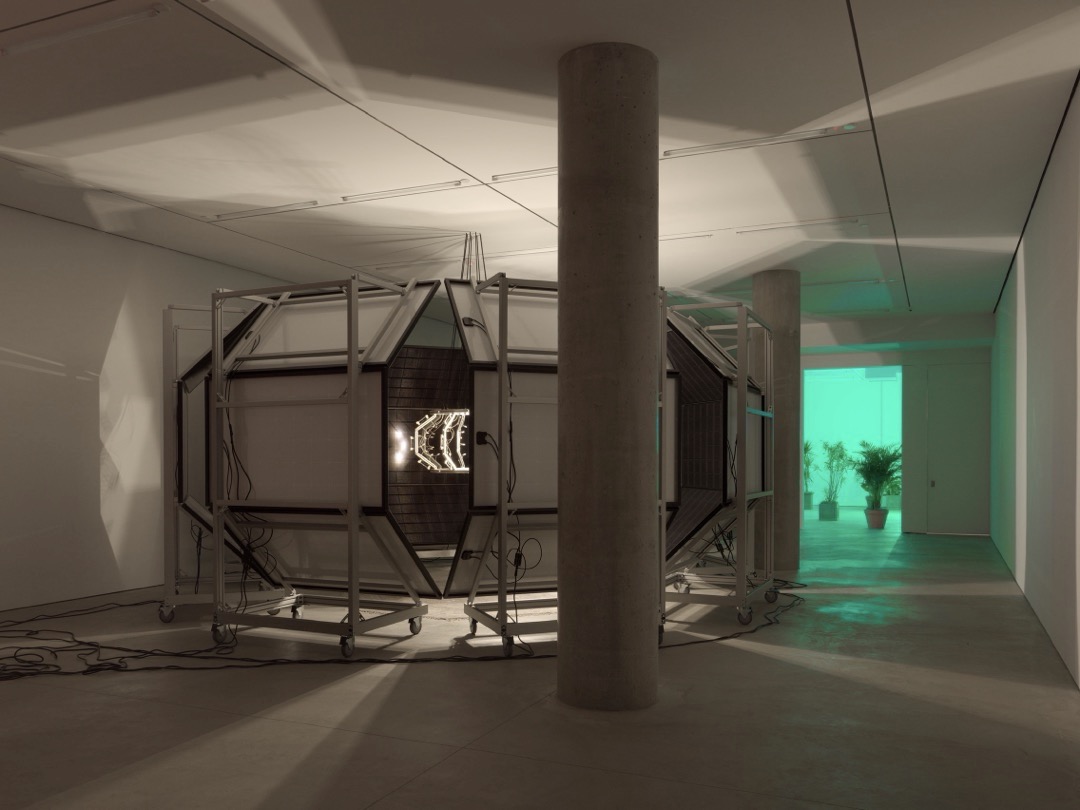
Haroon Mirza A Dyson Sphere for Schumann
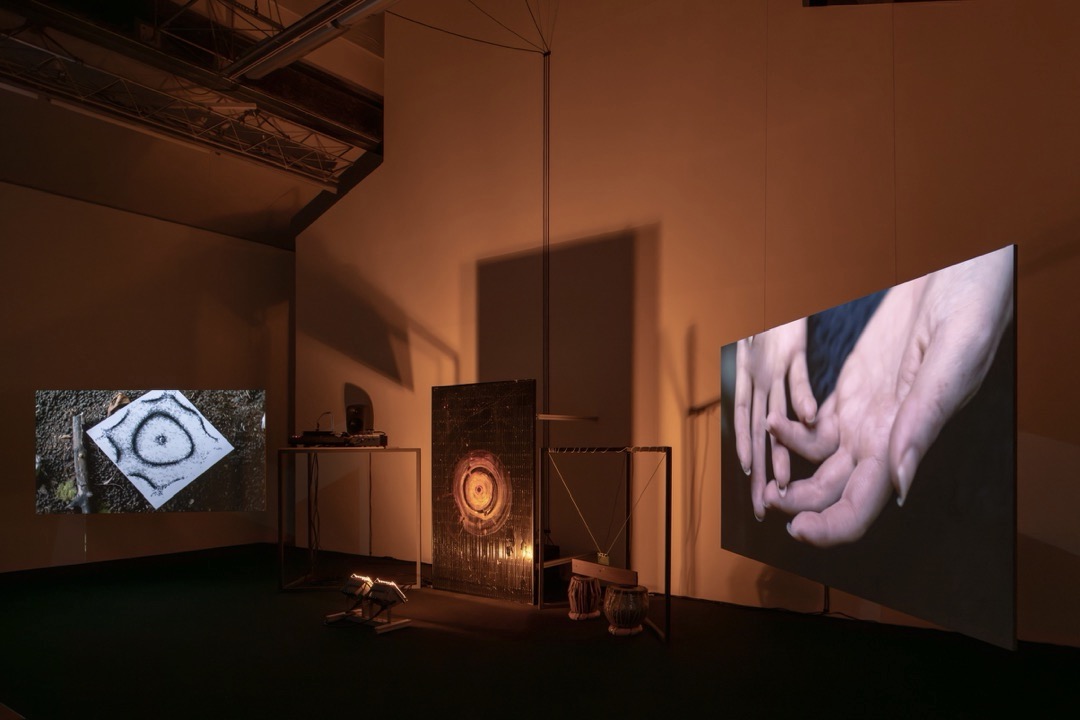
Haroon Mirza Cymatic Ceremony 2024
“Affordable workspace is pointless without affordable living space.”
Since the COVID pandemic, nobody goes into offices anymore. So it’s a no-brainer to look at how space is used. We need land reform. We need to look at use-class and building regulations. These are hurdles that can be combated. And I think the Creative Land Trust should be doing this, because it’s so important to invest in culture and make London a desirable place for artists. Prevent the exodus, and then turn it around so people want to come here.
PW: There’s an avoidance of what artists actually need. When you’re a creative, your life and work are quite interchangeable. You don’t leave it at the office. There’s a crossover. This idea of live workspace is something developers and wider people may not understand. But what do you think the resistance is?
HM: There is huge resistance. Post-COVID, there’s been a huge push about working from home, right? But that’s no different to living at work. There’s this conceptual thing where people say, “Well, I don’t want to live at work.” But what developers, councilors, and the government don’t understand, for many artists, is that work is life.
When I make, my practice is a part of my life. It’s something I just do. It doesn’t matter if I have no income – I’m still doing it.
“My practice is a part of my life. It’s something that I just do.”
I’ve had people come to my studio and say, “Oh, so that’s your hobby.” And I say, well, no, it’s not my hobby. It’s my vocation. It’s how I earn my living. But it’s also my hobby, right? And that thing is just not understood or respected or officially accepted.
There needs to be legislation or something in place. A lot of work has to be done to establish this as a modus operandi for artists. Or do things like they do in France or other parts of Europe, a universal basic income for artists or tax relief. But there’s none of that here. So securing cheap space is our only incentive, unfortunately.
PW: When you don’t have permanent space, how does that affect your work? Each studio seemed to affect what happened next in your career.
HM: The reality is that the art market is dead. I haven’t had an income from selling my work for a while, there have been some sales, but very few. In the last seven years, I haven’t had a decent income from making artwork that can be sold. But the majority of my projects are with museums and institutions with fees and production budgets, which requires space. Not being able to do that is really crippling. It’s a downward spiral.
I think having just space to try things out, so much can come out of that. But we haven’t got the conditions. This isn’t to do with CLT or that kind of initiative. It’s to do with governments not investing in culture, and instead actually cutting money out of culture. That’s really sad.
PW: And finally, a reflection. What’s one lesson you’ve learned from having a studio? It could be any studio you’ve ever had.
HM: Space,how it’s designed, how it’s programmed and how it’s used is so important. Not just for artists, but for everyone. Call it Feng Shui or design, it’s really important. Every time I enter a space, whether it’s a cupboard or a big warehouse or a beautiful house or a flat in Brixton, it needs to be laid out and designed in a way where it’s productive, where it’s creative, and where it helps you do things.
“Every space needs to be laid out and designed so it helps you do things.”
PW: I tend to change the layout of my rooms every six months to match the season of what I need to do. Space design is not easy, but very important once you get it right.
HM: We evolve, don’t we? Things change, and we want different needs. So yeah, it’s normal to do that.
About Haroon Mirza
Haroon is an artist working with electricity, sound, light, and materials to explore our relationship with consciousness and the boundaries between natural and artificial worlds. He won the Silver Lion at the Venice Biennale and has exhibited internationally. He was previously a trustee of Creative Land Trust and remains an ambassador for the organisation, though as this interview reveals, he is also navigating the very affordability crisis CLT exists to address.