Artist Ambassador Florence Peake
As the year comes to the end, we catch up with Creative Land Trust Artis Ambassador Florence Peake. Known as one of the UK's most distinctive performance and visual artists - working since 1995 - Florence moves between sculpture, painting, dance, text and film, building work around the body and the materials it meets. Florence’s performances and paintings have been shown at the Venice Biennale (2019), in the Hayward Gallery's touring British Art Show 9 (2021–22), and at venues including the De La Warr Pavilion, the Palais de Tokyo and the Whitechapel Gallery.
In this conversation we delve into the clash and collision between forms, how materials choreograph the body, and why making work with others matters to her. She also reflects on what it has taken to keep making in London.
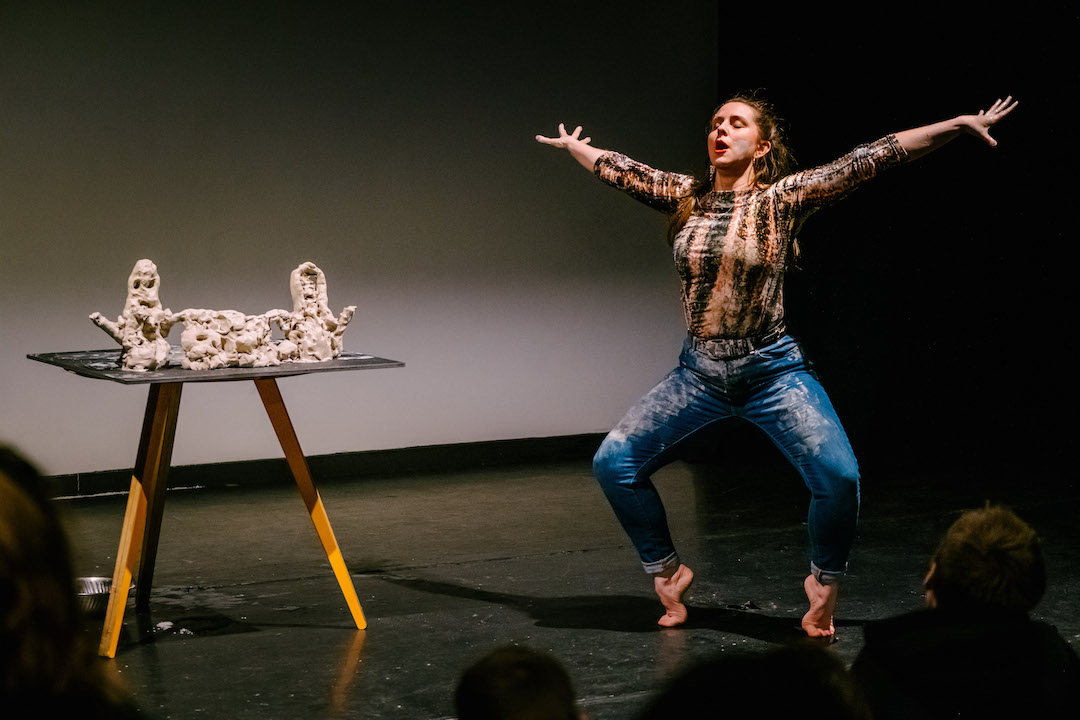
Piarve Wetshi (PW): Hi Florence, it's good to talk with you today. Describe your practice in less than 10 words.
Florence Peake (FP): I work with lots of different media, different forms and disciplines, in a way where I like to see how they collide and clash and crash into each other, and how they might form new kinds of languages between material, body and thinking. I hope that's less than 10 words.
PW: It feels short enough! I liked when you said clash and crash. What was your first ever studio like, and how did that impact your career?
FP: I've always been quite impatient as an artist, so I've always worked in whatever was available. The kitchen table, a corner of a sitting room, my bedroom, or finding spaces that I could use. I worked as a dancer for years, working with movement, material and the body. It was always about finding space to be. Maybe staying after a dance class to find a space that was free for half an hour. That was about 33 years ago when I started. I had a little space in my parents' home for a while.
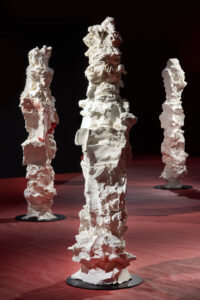
Haroon Mirza Lamp for Williamsii, 2016
The landscape is very different now to the 90s when I was growing up as an artist. There was a lot more free space, or spaces you could find, like in a derelict building. I was living in a squat in South London for a while, so there were spaces like that that I'd use.
In terms of my career, the space would dictate the scale of the work. Engaging with institutions or the bigger context wasn't something I had for quite some time. I can look back and feel quite romantic about those periods, but at the time I found them quite frustrating. Now I think it was a really wonderful thing, because it was much more DIY, hands on, and engaged with locality.
“The space would dictate the scale of the work a bit.”
PW: I was interested in the connection between yourself, the body and materials. I especially found it fascinating the way you use people in clay, such as in RITE (2017), and the shapes that come out of that. What did that discovery process look like?
FP: I started with what was immediately there, domestic objects. Growing up in London, it was very much my body in relationship to the chairs in the room. Turning a chair upside down and seeing what it really is. When I’m thinking about how materials or objects in the world choreograph bodies, I’m working with the object on its terms, but pushing it to its limits.
I put myself and other performers into a space with loads of objects, everything from teacups to ladders to things found on the street; and explored the language that happened with my body in relation to them.
I moved on to wanting to explore wet materials. Such as plaster, how it might set, what happens with the body. Then clay. I find clay a very psychic medium. It holds memory, and it holds an impression of something. It’s how the material responds to my gestures and actions. I’m collaborating with the material.
It can be an extremely frustrating process. When I worked with up to six tonnes of clay, it became like a mad weather system that I had no control over. A whole section of the performance was the dancers sliding and slipping around like worms, because there wasn’t any practical way to do anything else.
“It became something like a mad weather system that I have no control over.”
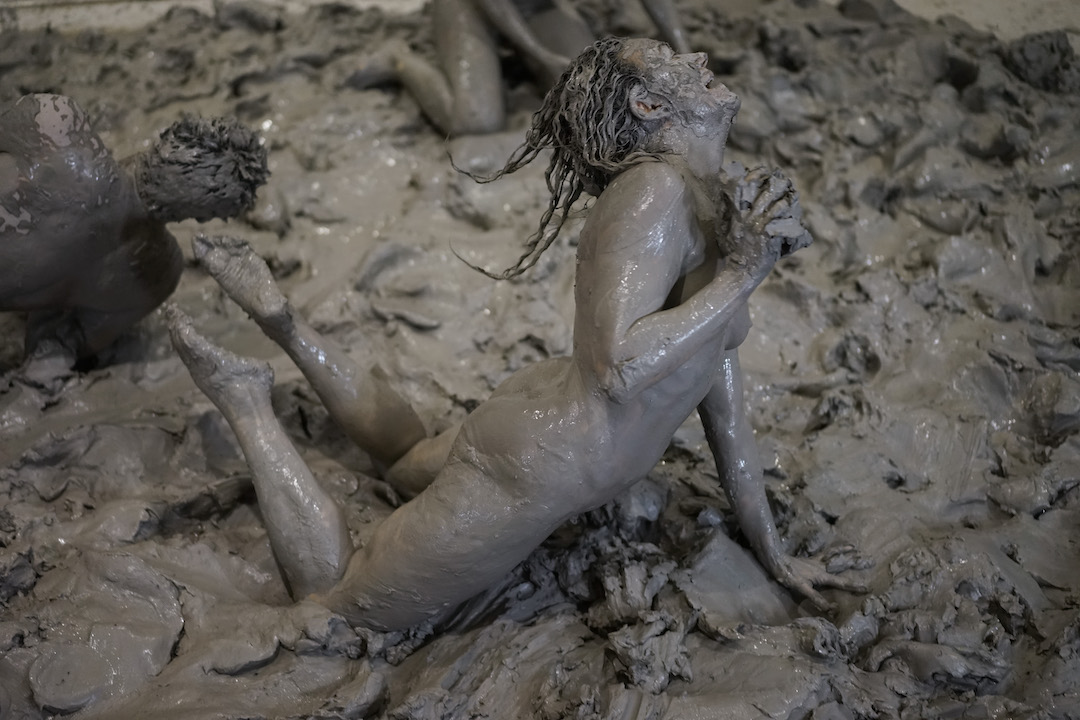
Image: RITE: Florence Peake. Performers Susanna Recchia and Iris Chan. Photo: Anne Tetzlaff.
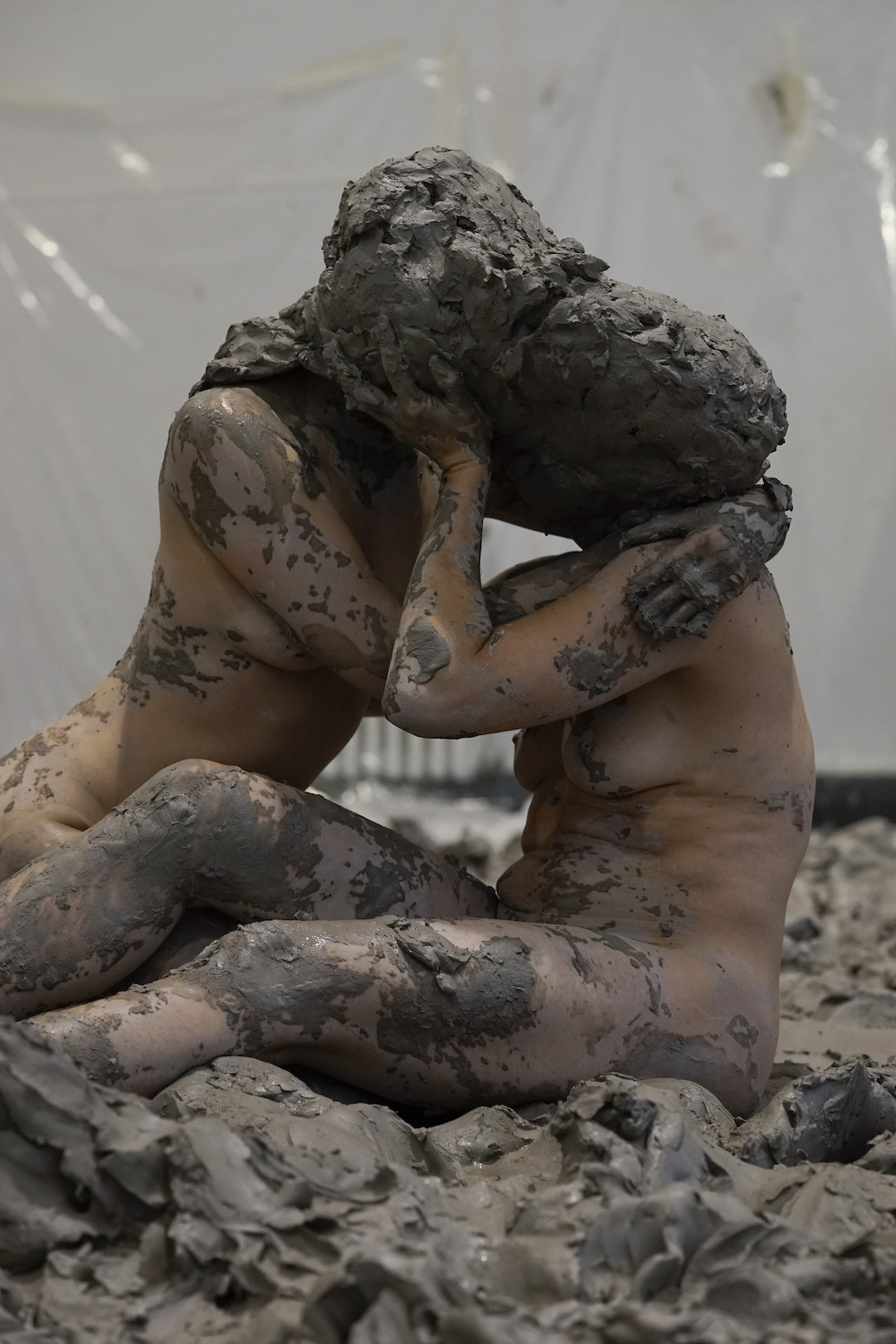
Image: RITE: Florence Peake. Performers Susanna Recchia and Iris Chan. Photo: Anne Tetzlaff.
PW: Movement is a big part of your work. How did it become part of the process, and what does it let you share that a piece of clay or an artwork may not?
FP: All of my work is heavily related to movement, that was my formal main training. I didn't go to art school. I did dance training in the 90s, then I studied in Seattle, in America, a particular dance technique which I still teach today, Skinner Releasing Technique. I moved more into somatic dance, and I teach a lot in that field.
PW: You put yourself into your work, and you choreograph a lot of it. Has dance given you that level of self-awareness?
FP: I suppose it's a habit. It's where I started as an artist. I was always painting as a child. My partner is also a dancer and performer, so everything we make together is a language that's very familiar, that I trust.
It's funny to be asked this question now. I'm going through menopause which has made me question a lot about being a dancer and performer, and it's been quite a tough time. I've just been asked to perform in Paris, in a collaboration with a Taiwanese painter called Yahon Chang, who's in his 80s. He paints and performs, I paint and perform. I feel terrified, actually!
PW: When I looked at your work, some of it felt like a call and response between you and the community around you. How has that changed your relationship with making? And how important do you feel it is for artists to be connected to their local area?
FP: I was very involved in organisations that did dance, art and health: Entelechy Arts, and Heart and Soul, who are based at the Albany in Deptford, and Dance Art Foundation. I worked in hospices and at the Maudsley adolescent psychiatric unit. I spent two years with another choreographer and dancer (Kirstie Richardson doing work there.
For me, I've worked a lot in community contexts, teaching, and experimenting with ideas in groups, then refining and developing them on my own. So there's always been inclusivity in that. A lot of the objects I make are collaborative. Painting is probably the most solitary, with more private processes, but a lot of it is collaborative.
Now, to get Arts Council funding, you have to have community or social engagement in some way. I think that's quite unfair to certain artists who don't have that in their practice. But there are lots of ways you could include people, in the work rather than in the making.
I think being an artist in this day and age, in late capitalism, is actually a radical thing just to be making and doing something that is working imaginatively with the world, rather than having an enforced engagement in a particular formulaic way.
PW: With the different art forms you work with, you'd need different spaces. What has the ideal space looked like throughout your career?
FP: Quite a lot of hustle, really. The dream space would be a dance studio within a shared block, and a shared ceramic studio with a technician, where you can share things easily between people.
PW: Was there a moment in your career when you got your big break, and what did that look like?
FP: For a good 20 years, it was me creating my own contexts, with friends, putting on shows in different places. I created a day of dance at Spitalfields Church, inviting artists to occupy the crypt and the main space. We did performances throughout the day.
Then LADA, the Live Art Development Agency, ran a thing called DIY. We went and pitched ideas to Yorkshire Sculpture park, including Oreet Ashery, Joshua Sofara, me, Jordan McKenzie and others. They didn't give us any money, but they said we could do all the ideas, as long as we did the fundraising. That was the first time I got Arts Council funding, in 2011. It was also the first time I put money in the budget for proper documentation.
The work at YSP was about the theatre of the behind-the-scenes activity of sculpture making, a humorous parody with huge objects and materials. We made a massive sculpture in the space, and then through the choreography we dismantled it again. I made sure I got it videoed, and it took off a little bit on the internet.
It was the first Arts Council funding after I'd spent about 10 years applying. I'm dyslexic, and back then there wasn't the awareness around access needs. From 2011 to 2019 I started to get more funding opportunities, which paid for a proper videographer and really helped with getting noticed.
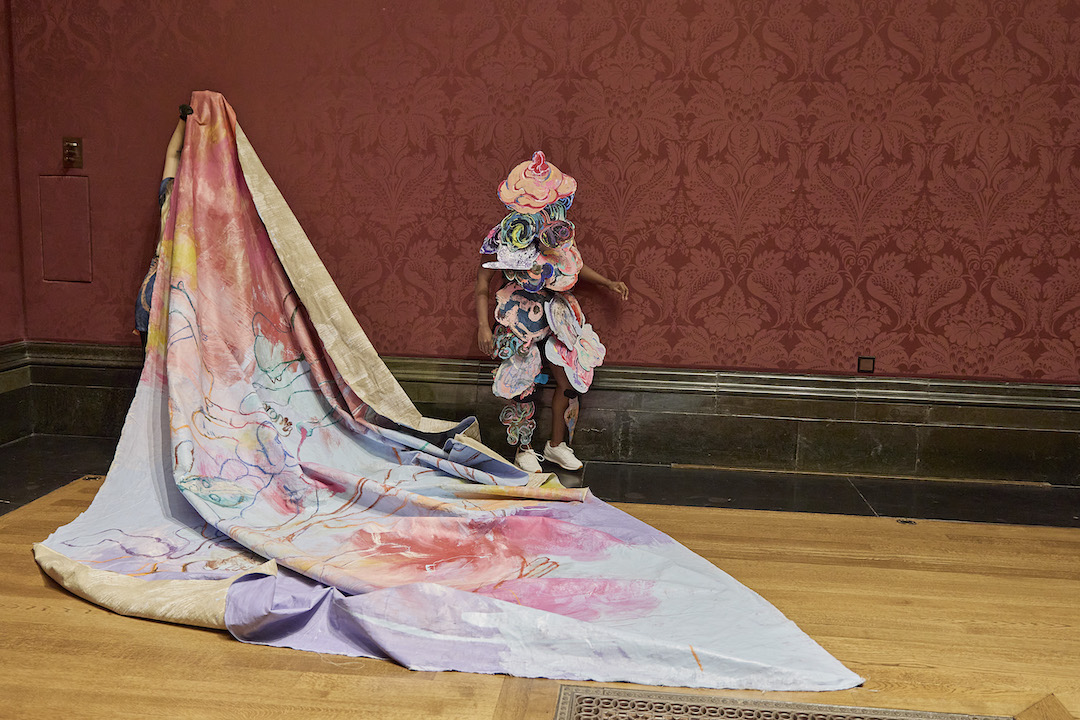
florence_peake_clt61
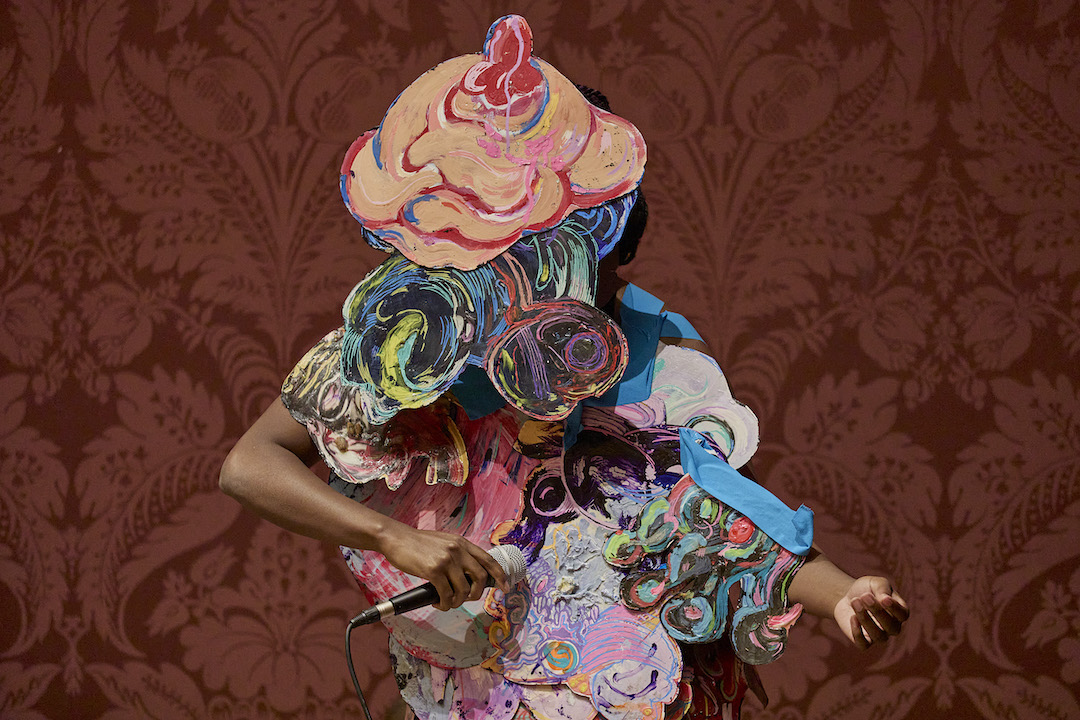
Image: Factual Actual: Florence Peake. Performer: Natifah White. Photo: Anna Arca
PW: I think that's very relatable to a lot of young and emerging artists. The pace feels so much quicker now, but hearing that it isn't easy, and that you get a lot of initial rejections, is important. How did you balance your career and living, while still self-funding a lot of your projects and looking for the next opportunity?
FP: For me it was about community, friends putting on things together. Things cost more now. I also had a family of artists, and they weren't well known then. I put on shows in my front room, performances in the kitchen, and in the squat, I was living in. It was drawing on friends and relatives and everyone. I hope young people can still do that.
There are online spaces now, which I didn't have, because there wasn't any social media when I was growing up as a young artist. But showing work is one thing, and surviving financially as an artist is another. Any place that can give studio space for free, or support artists in that way, is a huge thing, because living in a place like London is so difficult.
PW: You show a lot of resourcefulness. If you'd started your practice now, what would be different?
FP: I'd probably have had a mental health breakdown with social media. I personally find it very, very difficult, the social media side of being an artist. The live experience is such a different thing to the social media experience of the work. It's a painful labyrinth to enter, but I know it's necessary.
For me, the radical moment of being an artist would be about creating live places. It's much more intimate. I think it's a longing and a craving. That's what I would hope to be doing as a young artist now.
PW: It feels like the desire to withdraw from digital spaces, and the appreciation for slowness is emerging at the moment. As a Creative Land Trust ambassador, what are your hopes for the future of artists in the city?
FP: I'd hope that artists can reclaim and hold their space in the city; and connect to the value of what we're bringing into the world. Especially in times of such violence, and quite a lot of fascist thinking, we need to value ourselves in that way, by connecting with the value of what we're doing.
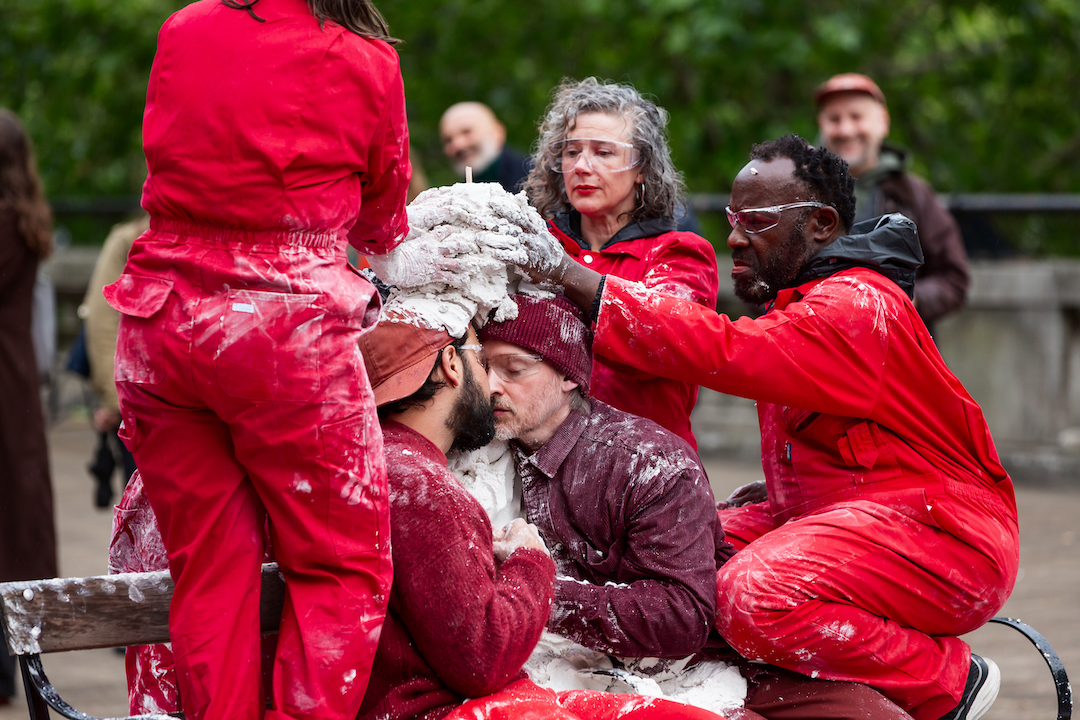
Image: Your Meaning not Your Materiality: Florence Peake. The Colab. Performers: Joe Moran, Donovan Morris, Catherine Hoffman, Rodrigo Peñalosa, Sophie Khan, Rachel Lopez de la Nieta . Photo: Henri T
PW: What are your thoughts on the challenges artists face in accessing affordable studio space? At Creative Land Trust we're constantly talking about the lack of long-term, permanent, affordable studio spaces for artists.
FP: Long-term affordable space, and the time. What can feel awful is that you have this space, but because you have to work and there are financial pressures, you end up only going into it one day a week. How do we give artists the time to really be in those spaces and occupy them? It's a difficult thing, having time to dream. I'd love to see more schemes where spaces are affordable, or even free. But also, for a parent with children, help with things like childcare, or paying rent. What are the other obstacles that stop you spending time in the studio?
PW: It's so common to be an artist by night and have a day job by day. Have you ever had a moment in your career without permanent space, and how did that affect your work?
FP: That's been more my reality, juggling lots of things. A year or two ago I didn't have a space. Now I've found a situation I can be in for a couple of years, but it's not permanent. There are lots of compromises.
PW: Some of your pieces look massive, and some take up a lot of wall or floor space. Could you talk us through the biggest piece you've ever made, and how you got the space to do it?
FP: That was the 50 metre painting, 3.8 metres high, which we made at Somerset House. A patron paid for me to have one of the downstairs arches for 1 year, which was a very lucky intervention. Before that I was using about half of one unit. The project was commissioned by Southwark Park Gallery. For the initial stage we had the whole of Dilston Grove, which is a massive space. We had two days to lay the ground of the painting, and do the community movement work and the drawing with the community onto the surface.
Then I took it back to Somerset House, where we used the six metre wall. My amazing studio manager, Jim Tuck, developed a spindle system, so I'd work on about five metres at a time and move it along. Then I'd be editing and developing the gestures and marks that the different groups had made. So it's developing apparatus and developing systems. I don't wait for the conditions to be perfect to make an idea happen.
The first time I saw the 50 metre painting in its entirety, as a complete work, was when it was being installed. It was hair raising, but good.
PW: Struggle and healing seem to come together in your work. What have you learned about healing over time?
FP: I've never really used that word personally. It's something other people talk about in relation to my work, which is nice. But what I do think is that I like offering spaces that counter late capitalism, with all its fear, anxiety, violence and dystopic spaces. There is something about offering space, or offering processes and ways of engaging, that think differently about the world we're living in. Spaces where we can feel ourselves, feel connected to others, and find something with some hope, some magic, or some play in them.
I often do workshops with people, touch-based practices, ways of connecting to each other that are different from the violence we see in the world. Places where there is some kind of love.
About Florence Peake
Florence is a multidisciplinary artist working across painting, sculpture, writing, dance and performance. Florence's practice explores how materials, forms and disciplines collide, and how the body and movement shape the work. Florence trained as a dancer, teaches somatic dance, and has developed work with partners including Somerset House and Southwark Park Gallery.
This interview is part of our In the Studio series, celebrating the artists working within our partner studios and the vital role that affordable workspace plays in sustaining creative practice in London.