

“Having space to work through anger, frustration, and hopelessness is healthy. Writing complaint letters wasn’t enough – I wasn’t expressing it. Journaling and the studio allow me to release that.”
We spent the day with Stratford-born artist Shirhan Mohamed, who brings us into her world. A self-taught filmmaker, who is experimenting with collage to share her latest project. We talk about the changes in Stratford, and how Shirhan is using her experiencing living in social housing and the activism work to bring awareness to poor housing conditions, has influenced her latest visual project.
Shirhan Mohamed (SM): I’m Shirhan and I’m a tech worker. I started off working in film – I’m self-taught – and now I’m branching out into collage and experimenting with different mediums. Right now, I’m exploring social housing, which comes from my own experiences living in it, learning about its history, and investigating the neglect that exists.
Rebecca Sainsot-Reynolds (RSR): Are you local to Stratford?
SM: Yeah, I grew up here and I’ve been in the studio since January.
RSR: You’ve said so many interesting things about what you do already, a lot to unpick! What were you doing in film that led you to software engineering?
SM: I had no artistic background. In school, I did biochemistry. After graduating in 2017, I decided to try something new and applied to the Radical Film School at the South London Gallery, run by Saeed Taji Farouky. That’s where I learned some film theory and started making my own work.
It was good for meeting others who were at different points in their filmmaking journey. Before applying to the film school, I felt like an imposter, but being in that space gave me confidence and inspired me to become a more politically active artist.
RSR: That kind of space is super important. Many people come to art without a background in it. There’s no right or wrong way. And imposter syndrome is something everyone faces at some point. I’m curious about your social housing research. How are people encountering it, and have you shared it yet?
SM: In Stratford, I saw the vibrant estate I grew up in disappear, fracturing of a community and ugly new builds popping up. Unfortunately, the Stratford I knew has been hollowed out like many other areas in London who fell victim to gentrification.
Despite that push to leave there are communities hanging and fighting, my first taste of organising within housing was with London Renters Union. It started with conversations with neighbours about the disrepair and mould that affected us. From there we banded together to successfully organise to get the necessary repairs done. It was my first taste of how collective action can bring change!
Organising within the union, my neighbours and I were able to get further with the tenants’ rights knowledge acquired. A lot of us in London live in bad housing whether it’s private or social housing and seeing the toll it takes on our health mentally and physically is heartbreaking.
Through my research it’s been interesting seeing the ways in which people vocalise that harm because local authorities and private landlords often do ignore that harm. People are left in situations where they’re begging to be heard and to be validated that yes, what they’re going through is wrong and the situation should be fixed ASAP. Seeing the ways people utilise social media, blogs, local newspaper and traditional media to force the hands of landlords because one thing they hate is being shamed publicly. So, sometimes shame can really be your weapon.
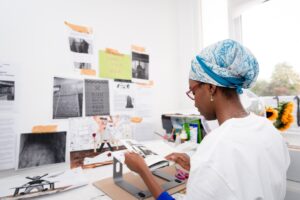
I’ve started to share the collages I’ve made from my personal experience and from what I’ve observed around me.
RSR: There is a strong sense of shifting agencies and accountability you are tracking here.
SM: Exactly. Lots of the people who make decisions own multiple properties, so they don’t reflect the majority of those who are renting tenants. I know it won’t solve all our problems but having more MPs who still live in social housing within government could bring about an attitude and priority shift, as governments have historically served landlords not tenants. Instead, we have heard the line, “I grew up in council housing” to show how far politicians have come, as if living in a council house is something you need to grow out of and graduate to something more “dignified” like a homeowner.
RSR: You’ve found collective activism with your community and the London Renters Union. But it’s hard – you shouldn’t need activism to get basic repairs.
SM: Yeah, when I was advocating for my family and I, at some point I was burnt out and had to pause. These systems feel like they are designed to exhaust you, even when you’re just asking for fair treatment and attention to issues that they should be managing and you are already paying for.
RSR: Being in a group helps – you can tap in and out, but it’s still exhausting. This is part of your practice, reflecting your personal experience within the context of housing struggles?
SM: There’s an indignity in having to prove something is wrong about your housing situation that you know to be true, like disrepair, but your landlord disputes what you can see with your own two eyes. So, you waste time gathering evidence because your word isn’t enough, then after all that effort and evidence – to then be ignored! It’s enough to make you lose your mind.
I’m trying to express it in a way that’s palatable, not just storing that anger inside.
RSR: What mediums are you using for this project?
SM: I’ve been experimenting with collage. It’s a way to express anger, disgust, and pain in a disjointed, uncomfortable way, it doesn’t have to be neat and neither does being angry
It’s a collage about living in a home affected by damp and mould. This isn’t unique to me – it’s common – many families across the country are dealing with it. Each of my family members were affected by the mould in our home in different ways, whether it was respiratory issues, to eczema flare ups. You would complain to everyone from local councillors, to local mayor, to the council, then get visits from the council to blame you for the mould and damp conditions.
I was thinking about my lungs, respiratory issues , and the damage caused after years of living in these conditions. Part of the collage imagines a revenge fantasy – making those in power reckon with what’s been done.
RSR: I’m hearing it’s a kind of self-cannibalistic revenge – gifting your rage.
SM: Exactly. I’ve internalised this damage, and the collage tries to convey that. I’ve sourced Homes and Gardens magazines from Freecycle, traveling to Dulwich to get them. It’s kind of funny that I used magazines filled with beautiful homes to make a collage about mould within a home.
RSR: It’s a lot to represent visually. Will you use your voice or written words in the practice as well?
SM: Yes, I’m experimenting. People can interpret the collage in different ways which is great but I do want to translate my research into writing, so I feel like nothing is left unsaid. I’d like to see more tenants leading interventions, rather than top-down cosmetic changes. I’ve been working on this research for a while! I’ve been learning more about social housing issues, from my own experience and research through archives too.

RSR: It’s nice to have a personal space to work from.
SM: Yeah, I can make it my own. This is my first studio. I know it’s a privilege because space is so hard to get. A friend came to see drafts and discuss my direction. It’s nice to bounce ideas off someone. I’ve been in my head thinking about these housing experiences, but it would be nice to work with others. Having space to work through anger, frustration, and hopelessness is healthy. Writing complaint letters wasn’t enough – I wasn’t expressing it. Journaling and the studio allow me to release that.
RSR: How do you put exhaustion, stagnation, and justice into an artwork?
SM: It’s hard – I want grotesque elements, especially around lungs, to reflect the experience. I have been translating my complaint letters and looking at the evidence that I’ve gathered when I was acting as housing advocate for my family and neighbours, I’ve tried to isolate things from that to explore. For example, reading old complaint letters filled with sadness and exhaustion that I wrote to my local MP to request help with a housing matter. I wanted that to be seen and acknowledged in the ways that it wasn’t, so I’ve used them in my collage.
RSR: You’re bringing such a breadth of research and personal experience into your practice – that’s a rich combination. I can’t wait to see how your work develops. Thank you so much for having me in your studio.
(Photography: Monika Szolle)