

“We knew it was going to be a space where we were going to spend lots of our time, and we were in the process of defining the product and the service. We also wanted to have a space that felt cosy and that allowed us to feel comfortable.”
We visit Aura Murillo, the co-founder of Resting Reef, a service that produces memorial reefs that also restore marine biodiversity. Rebecca, from Creative Land Trust uncovers the realities of turning a university project into a service, and how they balance honouring loved ones with beautiful structures, whilst protecting our oceans.
Aura Elena Murillo Perez (AM)
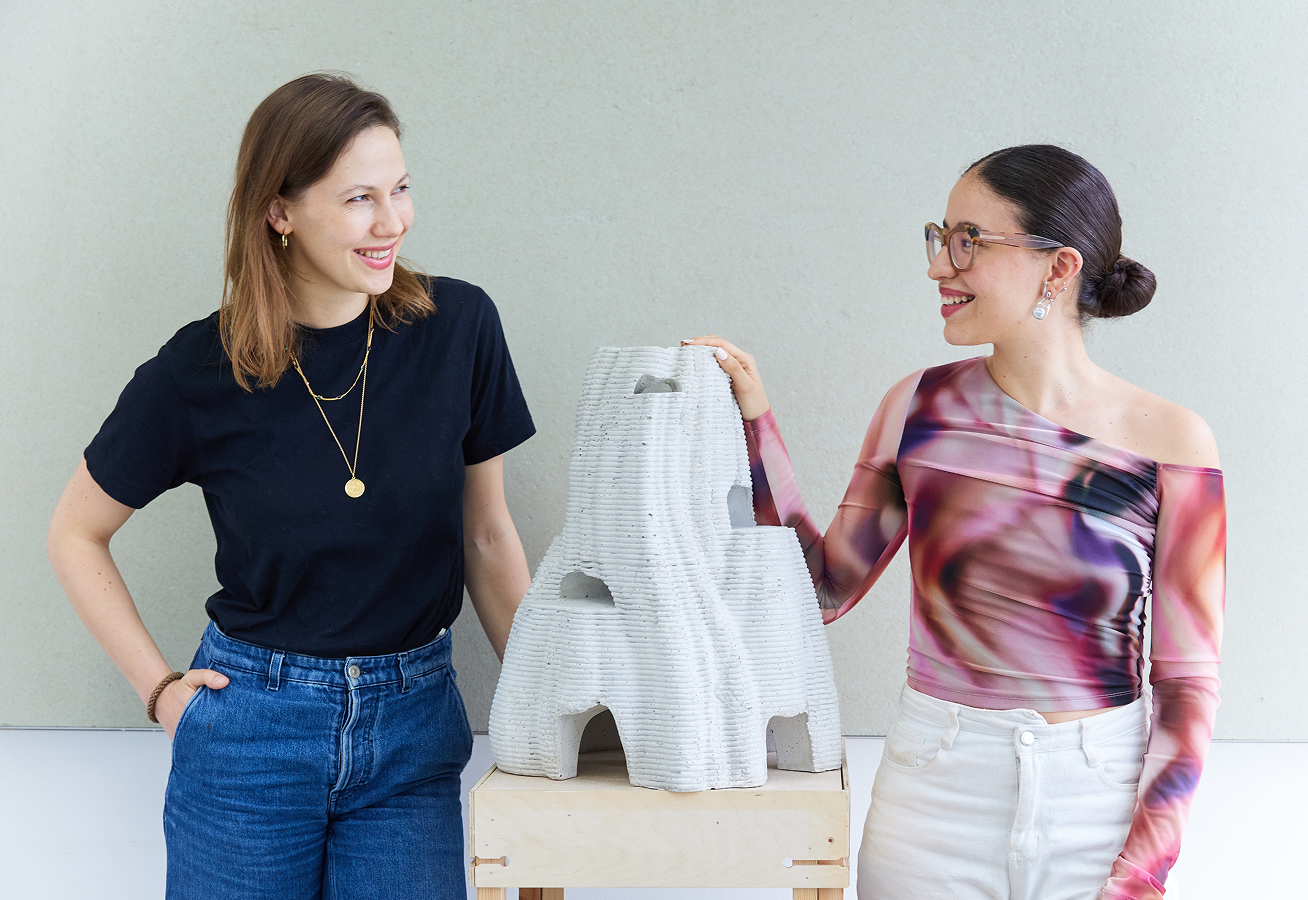
My name is Aura Elena Murillo Perez. I’m from Mexico City. I’m a designer, and the co-founder of Resting Reef, an impact-driven death care service. What we do is turn the ashes of those who have passed into sculptures that make up the memorial reefs, contributing to the restoration of marine biodiversity.
Rebecca Sainsot-Reynolds (RSR)
How long have you been in the studio here and how long has Resting Reef been developing?
AM: Resting Reef started almost four years ago as a student project, it wasn’t yet a business, but something that I developed with my co-founder Louise as part of our master’s degree. It’s been four years since the beginning of us ideating the project, we’ve been a business for three. When we graduated in 2022, we decided, based on feedback, that Resting Reef could be something valuable for people.
During university we had a studio space, working side by side which allowed us to time together to creating ideas and prototypes. After graduating the first thing that we did was start working from home and making prototypes there, but then we realised the messy side of it and the lack of that collaborative element we had with the shared studio, so we decided to look for a studio where we could both work together, with space – if the team grew. With a bit of online research we discovered Wallis Road Studios, while it was still being built, so we saw it from scratch. It was a no-brainer when we found out that it was subsidised and that there was support for creatives. At that time, we had just received a grant from Innovate UK so this was the perfect fit.
RSR: How have you found the studio, the artists and the community of creative businesses here and has the community in the building supported your endeavours in any way?
AM: When we arrived at the studio, it was a blank space, we decided we wanted to create something very personal. We knew it was going to be a space where we were going to spend lots of our time, and we were in the process of defining the product and the service. We also wanted to have a space that felt cosy and that allowed us to feel comfortable creating and developing our ideas. Something very important for us was taking our time with the arrangements and making the space ours, like painting the walls. Lousie had an interior design company, so she is very good at understanding what works well in spaces. We wanted to put up shelves to be able to display some of our prototypes. We also wanted to have a messier working station for the sculptures, but also a workspace for us to have a desk and work with our laptops. It’s been great because this is also the space where, whenever we have a potential collaborator, or someone that is interested in learning more, or even potential clients, we can have one-to-one conversations, and it makes everything a little bit more real and professional.
We’ve met lots of people from the community for example. It’s great to be in a community where you can see there are creative people on one side, but also on the other side, people who are building businesses, especially with sustainability in mind. We always appreciate the Wednesday lunches (weekly communal lunches for everyone at Mainyard Studios) and the community gatherings like the Christmas party.

RSR: How do you feel about Hackney Wick in general and as a place to work more widely and outside of this building?
AM: I always feel proud to say that I have a studio in Hackney Wick and from the creative side, I think it’s the place to be. There’s a lot of things happening, always an interesting event just a few footsteps away! There’s also lots of things like cafes and restaurants, and having the park area nearby, it’s just amazing – I love it!
RSR: Can we hear more about your work as Resting Reef and what you are up to at the moment?
AM: So overall we are a memorial service, and we currently have products or services for both human memorials and pet memorials. We provide families with an alternative and meaningful way of honouring loved ones that doesn’t stick with traditional or religious ways of commemorating. Then we have the environmental aspect of our business having a positive impact and supporting marine environments that currently are under big threat because of climate change and human activities. We have an active site in Bali, and it’s always been a dream to start something here in the UK, but we also see Resting Reef as something global, all around the world, where families have access, just as you have access to a burial ground or a cemetery, you can choose a memorial reef site for your loved one.
We’ve been working in the northern part of Bali, collaborating with the local community; who are increasingly facing the loss of socioeconomic benefits due to degrading coral reef environments. We provide a programme for the reefs to be restored that aims to also support the local economy.


RSR: Wow, that is an incredible project. How did you start this journey?
AM: My co-founder, Louise, is also a designer. We both did a dual master’s degree at the Royal College of Art and Imperial College London. Louise is an expert in sustainability and biomaterials and grew up in Norway. Caring about nature was something very natural to her, while I was the one who brought the death care aspect to the whole project, because I was already researching that topic. I was interested in emotional design. We had found some alternatives, such as urns made from salt that families use to scatter ashes, but we thought, what if instead of having something temporary, we created something that becomes a foundation?
Further into the project we involved someone who is now our Head of Restoration and Conservation, Dr. Isaac Boakes, a marine biologist based in Bali. He’s the one who allows us to assess everything related to the restoration aspect of the reefs. We’ve published our first annual Impact Report on the sites this month, and it’s been really positive. Our reefs have 174 times higher biodiversity than nearby degraded areas, and we have identified around 10,289 different types of fish!
RSR: How did you go about actualising the idea?
ΩWe started with pet memorials, which was a learning process that required working with and gaining understanding of the local community. We also started building relationships with end-of-life professionals, or veterinarians in the case of pet memorials, who are the ones who help us distribute the option of Resting Reef.
We recently started offering human memorials, which we offer through a service that can be completely remote. We handle everything carefully for the families; transporting the ashes safely to the memorial site location; crafting the reef with the local community; placing the reef underwater; monitoring the impact and sending families updates of how the reef is doing. We also give them a miniature version of their memorial reefs, and families can opt in to have a portion of the ashes of their loved one in this component too. Lastly, we send a certificate with the coordinates, and a photo with a plaque of their reef placed underwater. This contains updates where they can see if a new coral or fish appears in the reef!
RSR: Where are you now with the business?
AM: As a startup, we are in the process of fundraising, engaging people who want to support our mission and believe in what we do.
Now, we have another core member on the team, Wei Zhang, Head of Design and Production, who models the reefs and make sure that they are beautiful and that they comply with all the scientific elements of how they attract marine biodiversity.
We have members who come and go through university placements. Students who work with us and then go into areas such as design, impact assessment, engineering, business – many different areas of study.
RSR: That’s great that this started from your studies and you are giving this experience to new students. And how do you recruit those student placements?
AM: Through universities like Imperial College London, there are some programs that have placements as part of the curriculum where the students need to undertake real-world work experience. We partner to be one of the placement providers, but we also get a lot of interest directly from people reaching out with shared interests, asking if there’s a possibility to work with us.
RSR: Thank you for sharing so generously about Resting Reef’s journey so far.
(Photography: Willie Franklin and Resting Reef)
Read more about Resting Reef