Otto Alexander
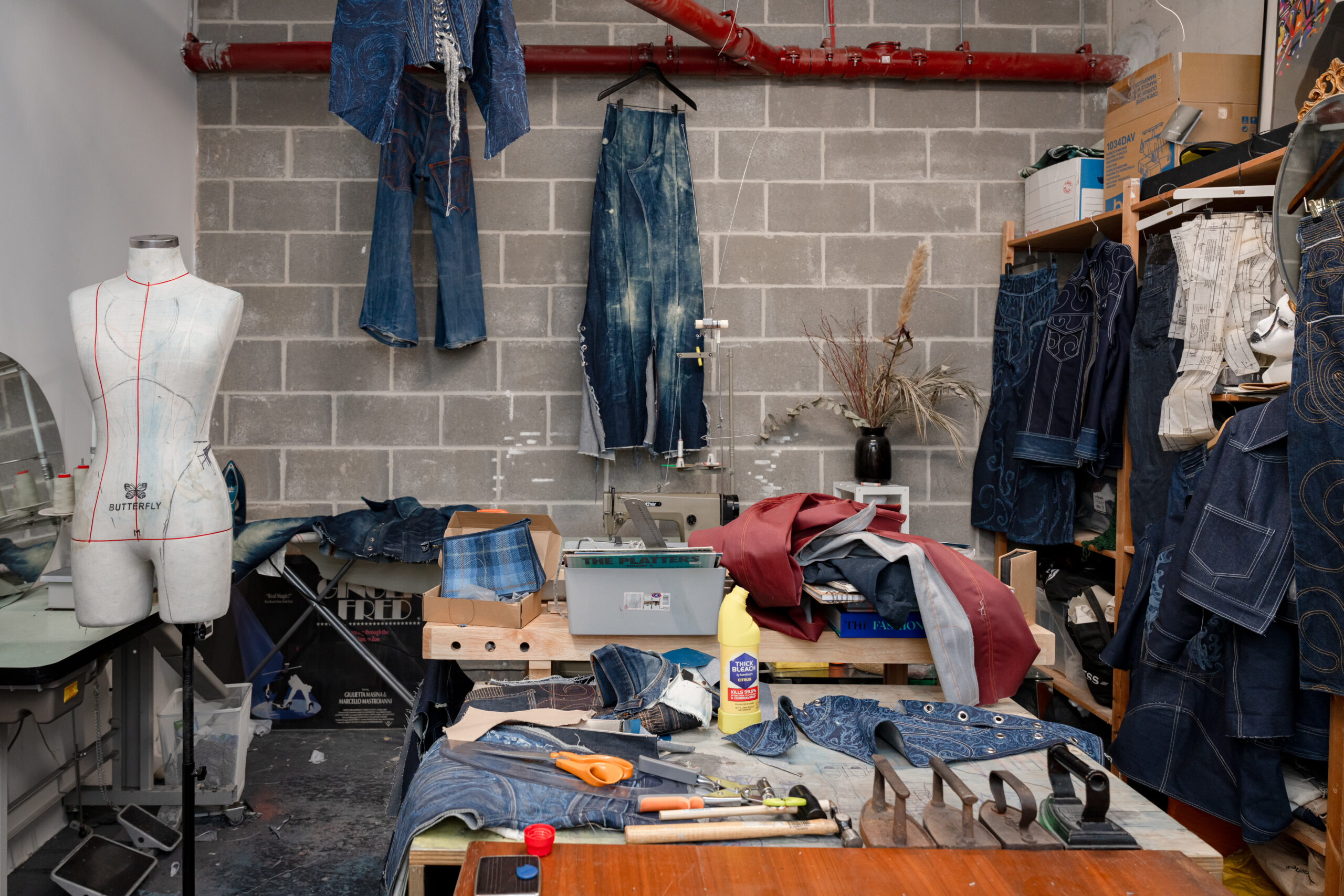
This month, we spent fashion week down in our Fashion District at Wallis Road Studios with knitwear and denim designer Otto Alexander. Otto is a denim designer running both a design and repair business from his studio in Mainyard Studios, one of our two studio providers based at Wallis Road, Hackney Wick.

“When you rush, people admire the speed, but they forget it just as quickly. When they see the process, when I send clients updates during construction, they understand the work and the value.”
Otto Alexander (OA)
My name is Otto Alexander. I have a design denim practice called Blues and Lonesome Denim. I also run a repair service called Darn n’ Duke, where I revive broken jeans. The denim design side creates custom, bespoke pieces for anyone who wants denim that truly fits them, not just off-the-shelf jeans. The repair service keeps your denim “singing the blues,” which is our catchphrase.
I’ve been at Mainyard Studios since the very beginning. I was at university doing my MA at the Royal College of Art and started cold-calling studios. I happened to call Mainyard Studios (MYS), and they told me they were building a new subsidised studio. I came to view the space when it was just concrete, and Tash (MYS) showed me the square footage of what my studio would look like. I’ve been here since then. Last year, I moved into a bigger space, and now I’m moving to an even larger one on the other side of the building.
Creative Land Trust (CLT)
That’s great. How long have you been practising as a denim-focused designer?
OA
After A-levels, I initially wanted to be a forensic psychologist, but my grades didn’t allow that. My ex-girlfriend’s mother introduced me to someone in fashion named Julie who wisely suggested I go into the arts! I had never sewn before, but I went to Nottingham to get a diploma, then Nottingham Trent University for knitwear. Later, Carlo Volpi invited me to the Royal College of Art for my Master’s.
Believe it or not, I didn’t actually sew until my third year of undergrad when I worked at a tailor’s in Nottingham. On the first day, they put me on the fastest machine, and my hand nearly went straight through it. That experience set me up for how I work now. I eventually switched from knitwear to denim for my Master’s. I used to write poetry, and my tutors asked how I could translate poetry into fabric. For me, denim works perfectly because it ages over time, reflecting personal histories and memories.
My grandmother used to draw with me, and as she got ill, she couldn’t hold a pen, so she made small swirl marks. I translate that memory into fabric by embroidering swirls throughout my work, almost like a photograph, embedding memory and poetry into what I create. I’m not a fan of putting my name on my pieces in big letters, so it’s something different to branding about the living with denim.
CLT
What a backstory, thank you!
How have you found the studio and the community here?
OA
Mainyard Studios has two sides with different practices sort of gathered together. On one side in particular, there is a small community of fashion designers, and we keep our doors open so you could come and go freely. The team at Mainyard create a real sense of community with events, shared lunches, and activities that bring people together.
CLT
The building is such a maze; I’ve noticed different pockets have different energies and practices grouped together. We’ve also met so many creatives who are juggling multiple jobs that may or may not be related to their craft.
OA
At the repair shop I work at in central London, most staff work there just to pay rent for something else. For many people, their passion lies elsewhere. Artists shouldn’t have to work long hours to fund their own creative practice. I was made redundant two weeks ago, so I immediately created a business plan for my repair service instead of dwelling on it. Finding investment is tricky, and not every creative or maker has the organisational skills to navigate that.
I’m lucky to have people around me who are focused and organised, my sister, for example. That kind of focus has helped me, but I know many artists struggle without support.
CLT
It sounds like you’ve hit the ground running.
OA
I have a clear vision of what I want my company to look like in the next ten years. The challenge is achieving it, but I’m putting my work out there.
CLT
How do you relate to Hackney Wick in general? Do you have a history with this area of London?
OA
I’m from Birmingham, so I had no clue about Hackney Wick before moving to London. The closest comparison I can think of back home is Digbeth. My girlfriend’s from the East End (of London), so I’ve learned a lot through her and her family.
Hackney Wick has changed massively. Like a lot of places in East London, it’s gone through heavy gentrification. Rents have shot up, and it’s pushing out the people who made the area what it was.
Luckily, because this studio is subsidised, I can still be here and contribute to that creative energy. But I’ve seen warehouses nearby where fifteen creatives used to live together, turning the space into a kind of living exhibition. That feels like it’s disappearing.
It reminds me of Peckham. I remember ‘Only Fools and Horses’ — and now there are wine bars and eateries everywhere. You think, where did that come from? Change isn’t always negative, but it does shift the identity of a place.
CLT
A great way to put it. Space for artists to remain in these new developments is what we are about, having an ongoing role in the story of the place.
Is there anything else you’d like to share that’s coming up for you?
OA
At the moment, my businesses are still growing. They’re not at a stage where I can massively publicise them yet, word of mouth travels faster for me. But really, it’s about awareness.
With Blues and Lonesome Denim, I want people to know I cater to all shapes and sizes. I trained as a tailor. I’m currently making an outfit for a woman whose proportions just aren’t accommodated by the high street. I want people to understand there’s an alternative to squeezing into something that wasn’t designed for them.
And with Darn n’ Duke, it’s about keeping jeans out of landfill. The denim industry is beautiful, but it’s also incredibly polluting. There’s a company in Kentish Town called Laundry who use laser technology instead of water to create wash effects. There are people trying to improve things, and I just want to contribute positively where I can.
CLT
It sounds like slow practice is a big part of that.
OA
Very much so. I’ve started slowing everything down. Normally I could make a pair of jeans in three hours. This pair has taken two months so far because I’m taking my time.
When you rush, people admire the speed, but they forget it just as quickly. When they see the process, when I send clients updates during construction, they understand the work and the value. It makes the price point make sense.
I want to guide clients through that journey, even give them something that shows the step-by-step process from toile to final garment. It becomes theirs in a deeper way.
CLT
It sounds like you’ve hit the ground running.
OA
I have a clear vision of what I want my company to look like in the next ten years. The challenge is achieving it, but I’m putting my work out there.
CLT
How do you relate to Hackney Wick in general? Do you have a history with this area of London?
OA
I’m from Birmingham, so I had no clue about Hackney Wick before moving to London. The closest comparison I can think of back home is Digbeth. My girlfriend’s from the East End (of London), so I’ve learned a lot through her and her family.
Hackney Wick has changed massively. Like a lot of places in East London, it’s gone through heavy gentrification. Rents have shot up, and it’s pushing out the people who made the area what it was.
Luckily, because this studio is subsidised, I can still be here and contribute to that creative energy. But I’ve seen warehouses nearby where fifteen creatives used to live together, turning the space into a kind of living exhibition. That feels like it’s disappearing.
It reminds me of Peckham. I remember ‘Only Fools and Horses’ — and now there are wine bars and eateries everywhere. You think, where did that come from? Change isn’t always negative, but it does shift the identity of a place.
CLT
A great way to put it. Space for artists to remain in these new developments is what we are about, having an ongoing role in the story of the place.
Is there anything else you’d like to share that’s coming up for you?
OA
At the moment, my businesses are still growing. They’re not at a stage where I can massively publicise them yet, word of mouth travels faster for me. But really, it’s about awareness.
With Blues and Lonesome Denim, I want people to know I cater to all shapes and sizes. I trained as a tailor. I’m currently making an outfit for a woman whose proportions just aren’t accommodated by the high street. I want people to understand there’s an alternative to squeezing into something that wasn’t designed for them.
And with Darn n’ Duke, it’s about keeping jeans out of landfill. The denim industry is beautiful, but it’s also incredibly polluting. There’s a company in Kentish Town called Laundry who use laser technology instead of water to create wash effects. There are people trying to improve things, and I just want to contribute positively where I can.
CLT
It sounds like slow practice is a big part of that.
OA
Very much so. I’ve started slowing everything down. Normally I could make a pair of jeans in three hours. This pair has taken two months so far because I’m taking my time.
When you rush, people admire the speed, but they forget it just as quickly. When they see the process, when I send clients updates during construction, they understand the work and the value. It makes the price point make sense.
I want to guide clients through that journey, even give them something that shows the step-by-step process from toile to final garment. It becomes theirs in a deeper way.

CLT
That reminds me, you mentioned at RCA your final show wasn’t a traditional runway?
OA
Our lecturer, Zoe Broach, was against doing a standard fashion show. At the time, we were frustrated – we’d invested so much and wanted the spectacle. But in hindsight, she was right. We did an exhibition instead. Some people incorporated live performance. My friend Miles even did a live rap. It felt richer than a standard runway.
Since graduating, I’ve done two fashion shows. One in Liverpool and one in London – and honestly, they were horrible experiences. I worked solidly for weeks just to get everything ready, and it didn’t reflect the time or care that went into the clothes.
I’ve even been invited to show at Paris Fashion Week, but for £3,000. If you understand the financial reality of emerging designers, that just isn’t feasible. That really cemented the idea that slower, more intentional presentation makes more sense for me.
CLT
So how are you getting your work out there now?
OA
If I’m being honest, I could do better. I could organise more photoshoots and create more awareness. But juggling multiple jobs makes that difficult.
Being made redundant recently has given me a push. It’s forced me to think I can’t rely on someone else for stability. I need to build my own community, find funding, maybe seek angel investors or grants, and make this practice financially sustainable.
With photoshoots, I want to curate them carefully. I want to be involved in how the work is presented. It’s beautiful seeing how others interpret your pieces, but I also need to protect the identity of the brand.
CLT
You mentioned the Christmas market locally?
OA
Yes, so I was part of that, and I will do different markets in the future. I’ll be offering repairs and selling some ready-made jeans in varied sizes. Again, just spreading awareness.
I’ve done Portobello Road before. The first time was great, lots of publicity and interviews. The second time, it was during a huge storm. The stall basically turned into a sail in the wind. It was miserable, but you learn from those experiences! Every opportunity teaches you something – even if it’s just that you survived a hurricane in double denim.
CLT
That’s the perfect takeaway to end on! Thank you, Otto.
OA
Thank you.
(Photography: Monika Szolle)
Follow Otto’s work at Darnin” Duke
Instagram @darnindukerepairs